



News
Safety Rules for Concrete Pump Truck Setup & Operation
Mar. 20, 2026
The parking area for the pump truck shall be as open as possible to allow full extension of all outriggers. Check for surrounding obstacles to prevent the boom or outriggers from contacting buildings or other obstructions. The operator must have clear visibility of all corners of the working area.If the operator cannot observe the entire work zone or cannot accurately judge the distance between extended parts and adjacent objects, a dedicated signaler shall be assigned. It is strictly forbidden to operate the equipment in violation of regulations or leave the equipment running unattended.
Warning devices shall be used to isolate the work area from traffic and the general public in accordance with safety operation requirements.
The pump truck must be parked on firm, solid ground to ensure stability. Keep the pump truck away from pits, embankments, ditches, etc.The ground in such areas may collapse under outrigger pressure, affecting the stability of the pump truck. The pump truck shall maintain a safe distance from trenches, slopes, excavated surfaces, cables, etc.
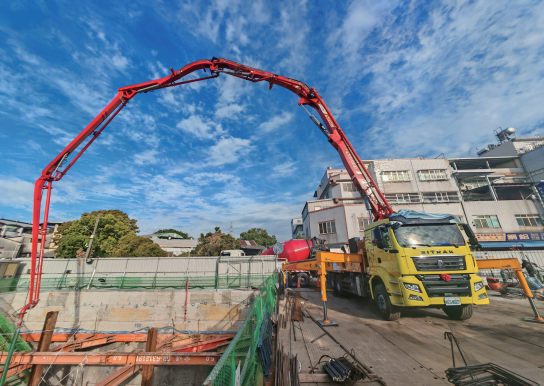
WARNINGWhen working on an embankment, unstable support may occur due to settlement of the supporting surface!
Supporting shall follow these basic principles:(1) The distance between the support surface and the trench shall be at least twice the depth of the trench.(2) The support surface shall be level. If located on a slope or uneven ground, a level platform shall be excavated for support.
WARNINGIncorrect parking position may cause instability or even overturning of the pump truck!
When parking on a slope, place wheel chocks behind the tires. Release the service brake, allowing the unit to roll slowly toward the chocks. Once the wheels rest on the chocks, apply the parking brake, secure the chocks, then extend the outriggers.
The pump truck shall normally be parked level. Level the truck by adjusting the outriggers.
The pump truck must be parked on firm ground to ensure stability. Ground pressure under outriggers can reach up to 26 kg/cm². If the ground is not firm enough, crosswise wooden mats must be placed under the outrigger feet.
The pump truck must be kept away from pits, embankments, ditches, etc.The ground in such areas may collapse under outrigger pressure and reduce stability.
During placing operations, constantly check and adjust the outriggers if necessary. Adjust outriggers to reduce torque caused by the placing boom in different positions, ensure outriggers stand on firm ground, and maintain overall stability.
The pump truck shall maintain a safe distance from obstacles such as cranes and buildings during operation.Extra caution is required near power lines to maintain safe clearance. Otherwise, personnel working on or near the pump truck or connected equipment (remote control, end hose, etc.) face a risk of fatal electric shock.When high‑voltage arcing occurs, a high‑voltage zone forms under and around the equipment. Stepping between different voltage zones (step voltage) allows current to flow through the human body.
DANGER! High Voltage!Keep the work zone at least 5 meters away from power lines.
NOTE! Wind speed requirement:Do not operate the placing boom when wind speed exceeds Grade 6 (13.8 m/s).
During operation, keep the pump truck level (maximum allowable inclination: 3°).NOTE! Excessive inclination may overload the placing boom slew mechanism and affect vehicle stability.NOTE! When setting outriggers, prevent body entanglement or crushing between outriggers and other objects!
Keep all personnel out of the placing boom operating area!
All outriggers must be fully extended and properly set during supporting.NOTE! Never extend the placing boom before all four outriggers are securely set.
Operate the boom only after outriggers are properly set. Conversely, retract the boom completely before retracting the outriggers.